On November 16, 2026, an address associated with the Lighter incident received 10,393,056.789298 USDC from Lighter's Ethereum contract. Lighter attributed the incident to a leaked API key for a trader's account and said its protocol and smart contracts were unaffected. Ethereum withdrawal, Lighter's statement
The executed records in Lighter's public Explorer show how the funds reached the withdrawing account. The attacker acquired shares in a pool associated with the victim, moved victim funds into that pool using an internal transfer, and redeemed the shares into the attacker's account. The final withdrawal then came from that account.
The important distinction is between who controls an account and who owns claims on its assets. A pool can have the same operator as the sending account while its shares belong to someone else.
The API key could move funds within one owner
Lighter uses API keys to sign operations on its trading rollup. An L1 wallet is the Ethereum wallet associated with the account. The documented permission model allows a normal API key to trade, manage subaccounts, transfer between accounts with the same owner, and request a secure withdrawal back to the account owner's L1 address. Transfers to a different L1 owner require an additional wallet signature. API key permissions
That destination restriction still leaves an important question: what can happen to funds before the withdrawal?
Lighter treats a Public Pool as a special subaccount. Its operator manages it, but other users can deposit in exchange for shares and redeem those shares later. A pool therefore combines an administrative relationship with a separate set of economic claims. Public Pool documentation
The SDK exposes that distinction. In the reviewed Python revision, sign_transfer takes an Ethereum private key, while sign_transfer_same_master_account does not. Pool creation, pool updates, share minting, and share burning also have API signing paths without that extra key parameter. These are client interfaces; the actual security rules must be enforced by the system that accepts and proves the operations. Pinned SDK signing methods
The executed path through one pool
The first sequence involves sending account 714710, pool 281474976415757, and the attacker-associated account 769455. Early public discussions of this route appeared in posts by 0xTria and gurtcrypto. The following movements are recorded as executed in Lighter's Explorer.
| Time on November 16 UTC | Recorded operation | Amount |
|---|---|---|
| 09:44:36 | Account 769455 mints 9,999,000 pool shares | 9,999.999900 USDC paid |
| 09:45:01 to 09:45:34 | Account 714710 makes eleven ordinary transfers into the pool | 10,383,864.265826 USDC in total |
| 09:45:38 | Account 769455 burns those shares | 10,392,825.879299 USDC redeemed |
| 09:46:44 | Account 769455 requests a withdrawal | 10,393,056.789298 USDC |
| 10:11:47 | Lighter's Ethereum contract pays the receiving address | 10,393,056.789298 USDC |
Pool transfer records, share and withdrawal records, Ethereum payment
These are gross movements. The redemption includes the attacker's deposited funds, and the account withdrawal differs from the pool redemption. Neither number should be substituted directly for a final net loss calculation.
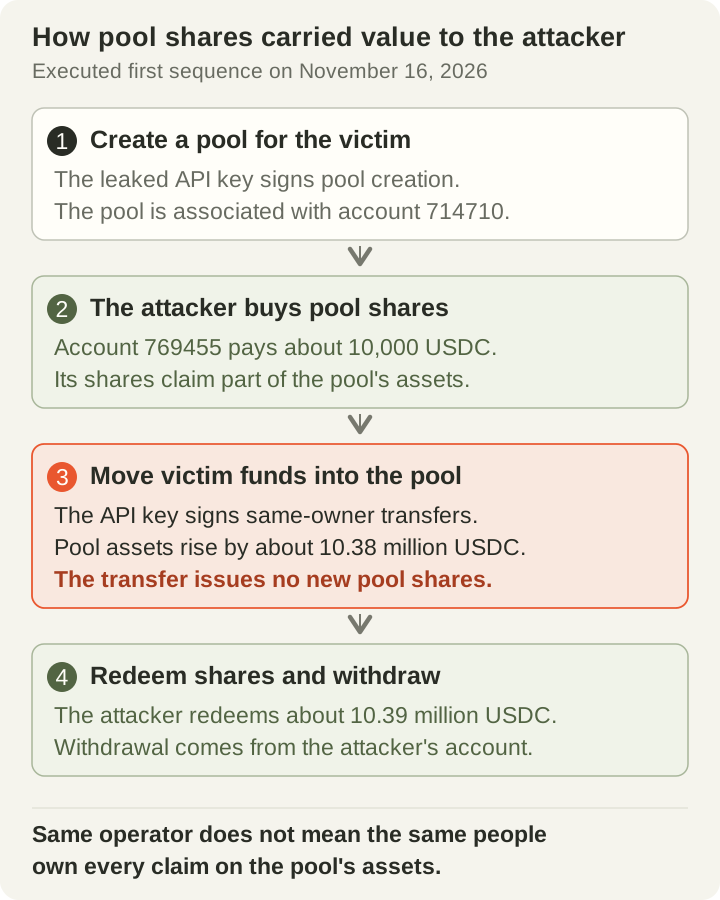
The value crosses into the attacker's account through a pool redemption. The documented secure withdrawal destination rule can still hold at the final step.
The Explorer also records a similar sequence involving account 714723 and another pool. Its related redemption and withdrawal entries had a null status in the response captured at 16:46 UTC on November 16, so they do not establish a second completed Ethereum payout. This article follows the executed first sequence. A public observation snapshot preserves the relevant responses and source revisions. Explorer records are indexed data from Lighter, rather than an independent replay of the rollup.
An ordinary transfer can increase someone else's claim
A pool share is a claim on part of the pool's value. In a simple pool without fees or other adjustments:
value of a share = pool asset value / outstanding shares
An ordinary transfer into the pool increases its assets without issuing shares to the sender. Existing shareholders then own the added value in proportion to their shares. By contrast, a normal share purchase adds assets and creates the corresponding claim for the depositor. Lighter's documentation describes share pricing as total asset value divided by total shares. Pool share pricing
For a simplified example, suppose an operator owns one share and another account owns 99 shares. The pool initially holds 100 USDC. If the operator transfers another 1,000,000 USDC into it without receiving new shares, the other account's 99 percent claim becomes worth 990,099 USDC.
The arithmetic can be correct throughout. The unsafe action is allowing a compromised operator key to make that donation from the victim's account.
This is why the same-owner check is insufficient for this path. The operator can remain the same before and after the transfer while the people entitled to redeem the assets are different.
The receiver check omits the share constraint
The most relevant public code is L2TransferTxTarget::verify in circuit/src/transactions/l2_transfer.rs. In prover commit fa85b33197710ece649739bc38f5e23e816ddbdf, dated November 2, the comment above the receiver pool check says that a pool may receive a transfer only while active and holding zero shares, using the Perps USDC route.
The actual predicate is:
let is_valid_receiver_pool =
    builder.multi_and(&[is_receiver_active_pool, is_to_perps, is_usdc_asset]);
It checks the pool's status, the destination route, and the asset. It does not include a condition that the receiving pool has zero shares. Receiver pool check
The difference is visible in the same function:
| Transfer direction | Conditions in the relevant pool predicate |
|---|---|
| Into a public pool | Active pool, Perps destination, USDC |
| Out of a public pool | Frozen pool, zero shares, Perps source, USDC |
The outgoing path constructs zero_shares_pool from the sender's public_pool_info.total_shares and includes it in the predicate. The incoming path has no corresponding receiver share check. Sender pool check
The transfer's state update applies asset and collateral changes. It does not issue pool shares to the sender. Share issuance and redemption are separate transaction paths. That combination explains why an ordinary transfer can increase the value of an existing shareholder's claim. Transfer state update, share minting, share redemption
The missing receiver condition is a concrete observation about this public revision. Connecting it to the production defect requires the circuit version used for the affected batches and the remediation diff. The executed logs support the transfer and redemption mechanism; they do not by themselves prove which source commit produced the deployed verifier.
Key permissions and circuit rules need separate protection
Two controls matter here. The key determines which actions an automated client may request. The circuit determines which state changes the proof can accept.
Normal API keys have enough authority to participate in this pool lifecycle. Lighter also provides read-only tokens and, for Premium or Advanced accounts, maker-only keys restricted to post-only orders and related order management. The exposed key's configuration and the route by which it leaked remain unconfirmed. Documented key restrictions
A narrower key can reduce the damage from a leak. The pool rule still needs to preserve ownership when a broadly authorized key is used. Requiring extra approval for pool creation or other asset management operations is one possible control. Enforcing a safe relationship between asset transfers and outstanding claims is another.
A policy consistent with the receiver comment would reject ordinary transfers into a pool that already has shares. Deposits into an operating pool would instead use the share minting path. Any such change needs to retain legitimate initialization, ordinary subaccount transfers, and share redemption behavior.
The regression that matters is a sequence: create a pool, admit another shareholder, then attempt a same-owner transfer into it. A test of the owner comparison alone can pass while missing the economic effect. The expected result must follow the intended pool policy, with both asset balances and share ownership checked.
A proof follows the rules it is given
A ZK proof can establish that a transition follows the circuit's rules. It cannot supply a condition that the circuit omitted, or determine whether the holder of a signing key is its intended user.
Lighter suspended withdrawals and pool creation, then announced Guardian mode and a contract upgrade through its Security Council. Those actions do not establish that the proof system's cryptography failed, and the announcement does not identify the exact constraint or contract change being deployed. Initial response, follow-up
The useful lesson is the ownership boundary. An account's operator may control a pool without owning every claim on its assets. A permission model must follow that distinction through internal transfers, share accounting, redemption, and the final withdrawal.
Thanks for reading. Keep following your curiosity.