A public blockchain makes money easy to verify. It also makes financial activity easy to observe. Once someone connects a Solana address to a person or company, they can inspect its balances, transfers, and counterparties.
Helius and Solflare have introduced a way to keep more of that information private. Helius launched Solana Privacy Rings on mainnet on November 10, 2026. Solflare announced Private Mode, its wallet integration with the protocol, on November 15. The default Ring encrypts assets and amounts while keeping sender and recipient addresses public. Solana Foundation announcement, Solflare announcement
The two companies work at different layers. Helius supplies the protocol and infrastructure. Solflare makes it available inside a familiar wallet. Solflare also offers an older feature, Private Send, which uses external providers to obscure the connection between a sender and recipient. Those two wallet features protect different information.
Why financial privacy matters
Consider a team paying contributors in stablecoins. A normal transfer publishes each payment amount. If the team's address is known, outsiders can compare compensation, estimate its spending, and follow its remaining funds.
A confidential payment can keep the amount private while still revealing that the team paid a particular address. That is a useful improvement for compensation privacy. It leaves the relationship between the team and contributor visible.
The same distinction applies to individuals and treasuries. Someone receiving a payment may need to know its amount without learning the payer's remaining holdings. A business may want verifiable settlement without publishing every financial detail to customers and competitors.
Solana already has other privacy mechanisms. Token-2022's Confidential Balances extension supports transfers with hidden amounts between configured token accounts. Rings add another approach: a programmable pool that holds existing assets in encrypted state on Solana. The significance of the recent releases is the combination of infrastructure and wallet access, rather than the first appearance of privacy on the network. Confidential Balances, Helius protocol overview
Where Helius and Solflare fit
Helius builds the Solana Privacy Program, the zero-knowledge proof system, SDKs, and services for finding encrypted records and generating proofs. Solflare builds the account setup, balance display, payment approvals, and recovery experience around those components.
For Private Send, Solflare uses a separate integration. Its March 2026 launch announcement named Houdini as the first provider in its Privacy Aggregator. Private Mode uses the Helius protocol directly and is separate from that aggregator. Private Send announcement, Private Mode announcement
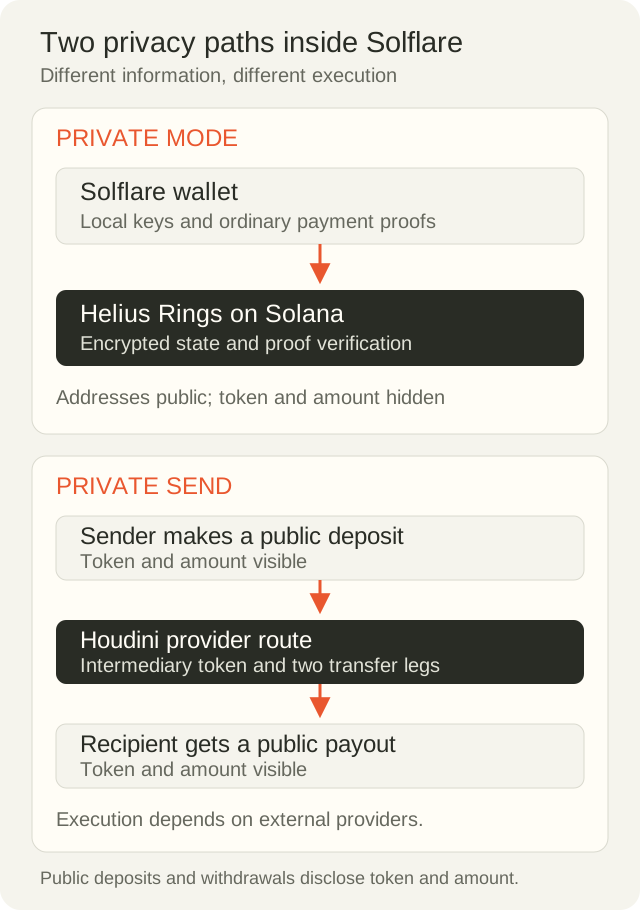
The first path protects financial details in Solana's recorded state. The second changes the path between public transfers. Ordinary Private Mode payments generate proofs locally; preparing a balance by merging records has a separate remote proving step.
How Helius Rings protect amounts
A Ring is a shielded pool: a Solana program holds deposited assets and maintains encrypted records of ownership and value. The default Ring is permissionless, so using it does not require joining an approved group. Helius documents support for SOL, SPL tokens, and Token-2022 tokens. A wallet's supported asset list is a separate integration decision. Ring properties
Encrypted records and proofs
A private balance is the sum of records the wallet can decrypt. The protocol calls these records UTXOs, or unspent transaction outputs. Each records an owner, asset, and amount, along with randomness used to hide its contents.
When spending a record, the wallet creates new records for the recipient and any change. A zero-knowledge proof lets the program check ownership and value conservation without reading the amounts. A nullifier, a unique marker derived from the spent record and a secret, prevents the same record from being spent twice. Commitments to records are maintained in a Merkle tree. Helius architecture, key and encryption model
This is ordinary execution on Solana. The Solana Privacy Program verifies the proof and updates private state; it does not settle on a separate chain. Public deposits and withdrawals use an interface that holds the underlying tokens for each mint. Program and asset interfaces
The code separates identity from financial details
The public SDK makes the boundary concrete. It publishes a tag derived from the recipient's signing public key, while encrypting the asset and amount to the recipient's viewing public key. The following sketch summarizes the default Ring output path; it is explanatory code, not a complete SDK example.
const publicOwnerTag = recipient.signingPublicKey.confidentialViewTag();

const encryptedOutput = encryptConfidential(
  transactionKey,
  recipient.viewingPublicKey,
  { assetId, amount, blinding, data },
  salt,
  slotIndex,
);
Despite its name, confidentialViewTag() returns the signing public key bytes after removing their type prefix. It does not anonymize the address. The proof circuit also binds public signer and output-owner identities while keeping UTXO amounts and assets private. The onchain program checks the resulting Groth16 proof. Output construction, public tag implementation, proof circuit, onchain verification
How Solflare makes Rings usable
Private Mode adds a private balance beside the public balance in an existing Solflare wallet. Setup derives privacy keys on the device from a signature by the existing Solana key, then publishes a record linking the usual address to the relevant public keys. Other users can keep using that address to pay it.
The registration record is public and permanent. Moving funds into the private balance also publishes the token and amount. Once inside, payments between Private Mode users hide those details from a blockchain observer. Moving funds back to a public balance reveals the withdrawal's token, amount, and destination. Solflare technical walkthrough
| Action | What a blockchain observer sees |
|---|---|
| Set up Private Mode | That the address has registered for private payments |
| Move funds to private | The source, token, and amount |
| Pay another Private Mode user | The sender, recipient, and time, with token and amount encrypted |
| Move funds to public | The destination, token, and amount |
Encrypted storage does not prevent every inference. If someone deposits 1,000 USDC, has no private activity in between, and withdraws it again, the public record gives away what they held. Hidden transfers between private balances make the balance harder to calculate, while matching amounts and timing can still provide clues. Visibility and inference examples
Who can see the private information
Solflare describes local balance decryption and local proof generation for ordinary sends and withdrawals. The user's signing keys authorize spending. Helius's indexer serves encrypted records without decrypting them, while Solflare's servers see when the wallet syncs and which transactions it submits.
There are two important exceptions to a broad claim that only the user sees financial details:
- Solflare can infer amounts and assets from its fee. Private payments include a proportional fee paid to Solflare. Its technical explanation explicitly says this lets Solflare work out the amount and asset of transfers sent through its app.
- Merging records uses a Helius enclave. A wallet with many small UTXOs may need to combine them before spending. Solflare says the app verifies this remote execution environment before using it. The enclave sees the records being merged and the secret used for their nullifiers. Spending authorization remains with the user in the documented flow.
These are different kinds of access. A service can learn payment information without holding the key that authorizes spending. Solflare information access and trust model
Costs and current support
Solflare charges a 0.3% Privacy fee for private payments and withdrawals to a public balance. It takes the fee from the private balance in the transferred token, in addition to the entered amount. A 1,000 USDC private payment therefore requires 3 USDC for that fee, and the recipient receives 1,000 USDC. Deposits have no Privacy fee.
Network fees always come from SOL in the public balance, including for a withdrawal. Setup has a one-time, non-refundable cost. A merge can also require a separate prepaid cost. Fee policy, merge preparation
At launch, private payments require both parties to have Private Mode set up in Solflare. An unregistered recipient triggers a warning; the sender can cancel or choose a public payment. Swaps, staking, Earn, and dApps use the public balance. Hardware wallets, Seed Vault, the Seeker app, and view-only wallets are outside the documented support for this version. Current support
How Private Send takes a different route
Private Send addresses a separate problem: the direct connection between a payer and recipient. Solflare's launch announcement describes routing through a provider, with amounts still visible onchain and processing taking minutes. Solflare Private Send
Houdini's API exposes a private send as a same-token route with two legs and an intermediary token. The client gets a quote, supplies the destination, receives an order with a deposit address, and sends the public deposit. The provider route then pays the recipient.
The following pseudocode follows that API contract. It describes the provider interface, rather than Solflare's app source.
const result = await api.get("/quotes/private-send", { token, amount });

const order = await api.post("/exchanges/private-send", {
  quoteId: result.quotes[0].quoteId,
  addressTo: recipient,
});

sendPublicTransfer(order.depositAddress, order.inAmount);
Houdini's public client implements the same quote-to-order pattern through its general endpoints. The dedicated API also allows this general integration for private same-token quotes. Orders expose deposit and payout transaction hashes, plus progress and refund states. The API operator can associate those order details. Public client, private send quote, private send order
The quote API includes an optional useXmr setting for a Monero intermediary. That option does not establish which route Solflare selects. The public interface explains the integration pattern; it does not expose the provider's complete routing implementation or prove how difficult a particular payment is to trace.
| Question | Private Mode | Private Send |
|---|---|---|
| What does it protect? | Private balances, assets, and payment amounts from public observation | The direct public connection between payer and recipient |
| What remains visible? | Counterparties and public deposits and withdrawals | Amounts and assets in the public deposit and payout |
| Where does the privacy mechanism sit? | Encrypted state and proof verification on Solana | An external provider route between transfers |
| Who can receive? | Solflare users with Private Mode configured | Any supported destination address |
| What does execution rely on? | User authorization, the Solana program, and supporting services | Completion of the external provider's order |
The practical choice follows the information someone wants to protect. A confidential payroll amount and an obscured payment relationship are different requirements. Neither feature establishes that every participant, service, and public observer knows nothing about the payment.
What the infrastructure makes possible
Helius extends the design beyond wallet transfers. Programs can hold private balances in escrows and enforce conditions for releasing them. The intended applications include swaps, lending, yield, and conditional payments that compose with other Solana programs. These protocol capabilities are broader than Solflare's current holding and payment interface. Programmability and architecture
Custom Rings add another configuration layer, including controlled participation, auditor visibility, and optional counterparty anonymity. They can also give designated authorities freezing or recovery powers. At the November launch, these were a subsequent release undergoing audit. Those controls and anonymity options should not be attributed to the permissionless default Ring. Custom Ring plans
Security remains part of the design. Groth16 relies on trusted setup parameters, alongside the security of the circuits and program. Helius's security page links Certora and zkSecurity reports and lists OtterSec as awaiting its report. Audit publication status
Solflare also documents that Helius's governance multisig can pause the protocol. If Solflare disables the feature in its app, it says moving funds to public remains available while other operations stop. An app switch and a protocol pause are distinct controls. Operational controls
The meaningful change is that financial disclosure can become a choice within applications people already use. Helius provides encrypted state and programmable verification on Solana. Solflare turns that infrastructure into a wallet balance and payment flow. Whether that is enough depends on the use case: private payment sizes, private holdings, hidden counterparties, and confidentiality from service operators each require their own answer.
Thanks for reading. Keep following your curiosity.